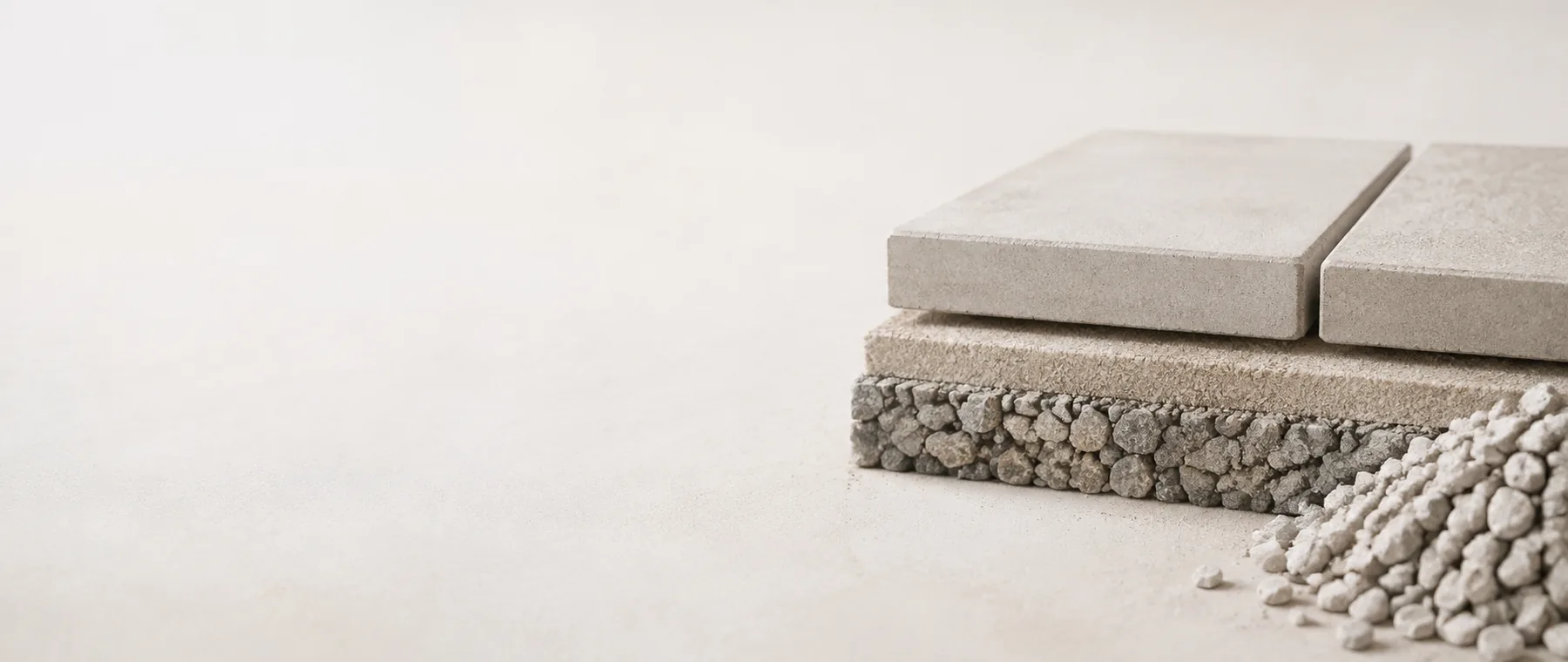
Paver Base Calculator
Size the base beyond the paved edge, calculate the compacted layer, then convert it to the loose volume you need to order.
- Extended base area
- 100 ft²
- Compacted base volume
- 50 ft³ (1.85 yd³)
- Loose volume before waste
- 60 ft³ (2.22 yd³)
- Loose order volume
- 60 ft³ (2.22 yd³)
The conversion factor is not a Proctor percentage. Do not also apply a density ratio or a second shrinkage allowance.
Show calculation
100 ft² × 6 in ÷ 12 × 1.2 × (1 + 0%) = 60 ft³ looseTransparent method and editable product assumptions. Verify current labels and project requirements.
How this calculator works
The base footprint can extend beyond the visible paving. The calculator adds the same extension to both sides of the length and width, then multiplies that footprint by the compacted base depth you specify.
Compacted volume is the finished in-place layer. Suppliers often sell a loose volume or weight, so the calculator applies one editable loose-to-compacted factor. A factor of 1.20 means loose volume is 1.20 times compacted volume.
A material described as losing 20% of its loose volume uses a different formula: 1 ÷ (1 − 0.20) = 1.25. Do not confuse either conversion with percent Proctor density, and do not apply both a shrinkage factor and a density ratio to the same order.
Formula
Base area = (length + 2 × extension)(width + 2 × extension); loose order = area × compacted depth × conversion × (1 + waste)The live substitution appears with your result.Control example: 100 ft² at 6 inches
The compacted volume is 100 × 6 ÷ 12 = 50 ft³.
At a user-supplied 1.20 factor, loose volume is 60 ft³ (2.22 yd³). A 20% loss from loose would instead require 62.5 ft³.
Assumptions and limits
- You supply the compacted layer depth required by the project.
- The same edge extension applies on all four sides.
- The conversion factor matches the base material, grading, moisture basis, and compaction method.
- Bedding sand is a separate layer and must not inherit the base factor automatically.
Common measuring mistakes
- Treating 80% or 95% Proctor as the loose-order conversion.
- Using 1.20 when the supplier actually means 20% loss of loose volume; that definition requires 1.25.
- Applying the conversion again after converting volume to weight with matched densities.
Sources
Product-specific values remain editable. These sources support the method and stated examples; they are not a universal substitute for your supplier’s current label.
- Unilock Advanced Technical Guide Distinguishes compacted layers, material properties, and Proctor density.
- Belgard Technical Resource Guide Separates compacted base from bedding material.
Questions people ask
Is a 1.20 factor the same as 20% compaction?
Only if you mean “add 20% to compacted volume.” If loose material loses 20% of its original volume, the correct factor is 1.25.
Does the calculator choose base thickness?
No. Thickness depends on the system, soil, climate, load, drainage, and manufacturer or engineer guidance. Enter the compacted depth already specified for your project.
Is bedding sand included?
No. Bedding is a separate layer with its own area, depth, density, and ordering assumptions. Use the Paver Sand Calculator.