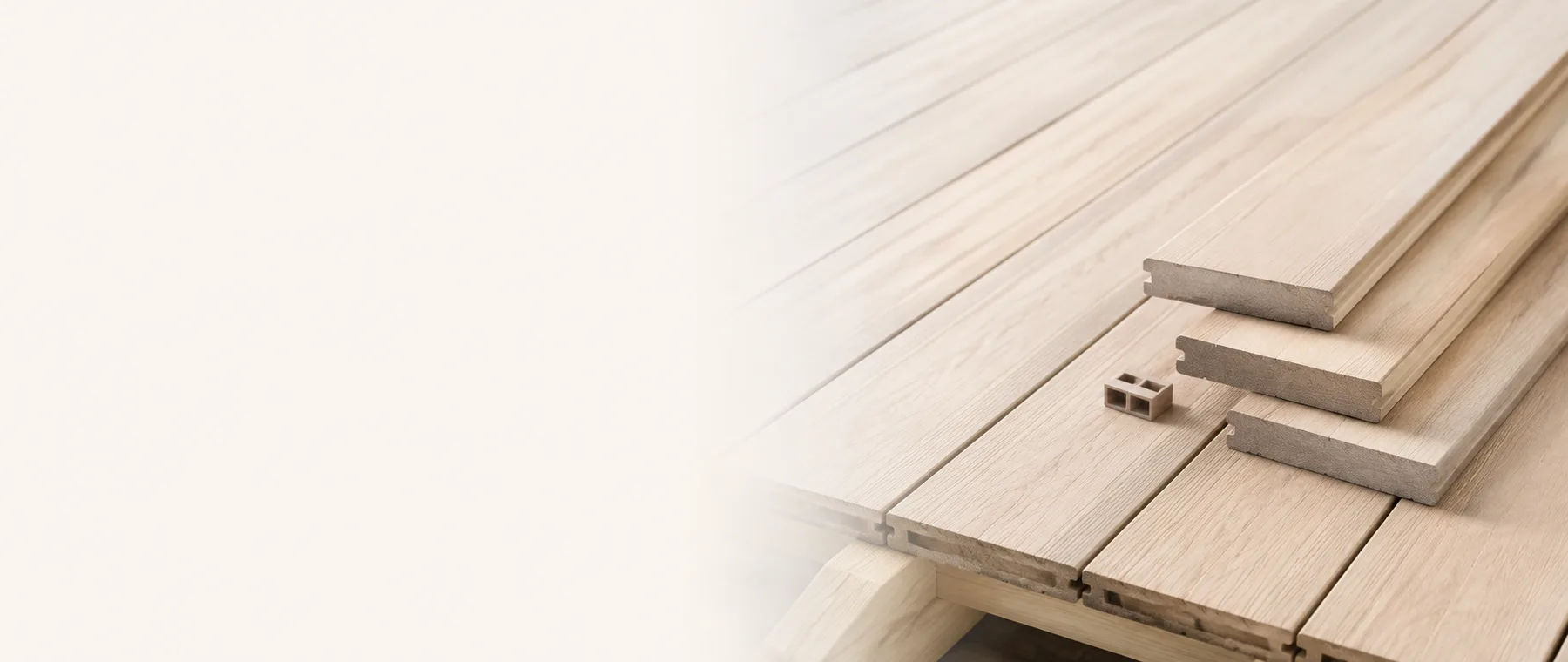
Deck Calculator
Calculate how many deck boards you need while keeping board direction, side gaps, course count, stock length, and offcut limits visible.
- Deck surface area
- 192 ft²
- Board courses
- 26
- Stock segments per course
- 1
- Installed board length
- 416 ft
- Layout stock boards
- 26
- Boards to order
- 29
Course count uses board face width plus the entered side gap. The stock count assumes each course is cut independently and does not optimize shared offcuts or design framing.
Show calculation
courses = ceil[(144 + 0.25) in ÷ 5.75 in] = 26; segments/course = ceil(16 ÷ 16) = 1; ceil(26 × 1 × 1.1) = 29 boardsTransparent method and editable product assumptions. Verify current labels and project requirements.
How this calculator works
Board direction decides which deck dimension is the course length and which dimension must be covered by repeating board faces and side gaps. Because the last board has no gap beyond its outside edge, the calculator adds one gap to the covered span before dividing by board width plus gap.
Every course then needs enough full stock lengths to cross its run. The calculator rounds stock segments within each course before applying one whole-board allowance. That is more conservative than dividing total linear footage by stock length and pretending every offcut can move anywhere.
This is a deck-surface quantity calculator, not a framing or structural deck designer. It does not choose joist spacing, beam size, post footing, ledger attachment, fasteners, stair geometry, breaker boards, picture-frame borders, diagonal layouts, or code requirements.
Formula
Courses = ceil[(covered span + one gap) ÷ (board face width + side gap)]; boards = ceil(courses × ceil(run length ÷ stock length) × allowance)The live substitution appears with your result.Control example: 12 × 16 ft deck
Boards run along the 16 ft length. Across 12 ft, 5.5 in boards with 0.25 in gaps require 26 courses.
With 16 ft stock, each course uses one board. Add 10% and round up: ceil(26 × 1.10) = 29 deck boards.
Assumptions and limits
- The deck surface is one rectangle.
- Boards run perpendicular to already designed and approved supports.
- One actual board width and one side gap repeat across the field.
- Each course is stocked independently; shared offcut optimization is not assumed.
Common measuring mistakes
- Using nominal 6-inch width when the actual board face is 5.5 inches.
- Ignoring the manufacturer’s temperature- and product-specific gapping instructions.
- Dividing deck area by board face area without accounting for gaps and stock-length cuts.
- Treating a surface-board estimate as structural approval of the deck framing.
Sources
Product-specific values remain editable. These sources support the method and stated examples; they are not a universal substitute for your supplier’s current label.
- Trex deck resurfacing guide Demonstrates dividing the covered frame dimension by actual board width plus a specified side gap and directs users to product gapping instructions.
- The Home Depot deck material guide Separates decking width and length, stock pieces, layout rows, fasteners, stairs, and a typical editable 10% waste allowance.
Questions people ask
How many deck boards do I need?
Choose the board direction, divide the perpendicular deck span by actual board width plus side gap, round up the courses, then stock enough length for each course and add allowance.
How do I calculate deck board spacing?
Do not invent a universal gap. Use the current installation guide for the exact product, material, moisture or temperature conditions, fastener system, and drainage requirements.
How many deck boards for a 12 × 16 deck?
With 5.5-inch faces, 0.25-inch side gaps, and 16-foot boards running along the long side, the field needs 26 boards before allowance and 29 with 10%.
Can offcuts reduce the number of boards?
Sometimes. This calculator stocks each course independently. A verified seam and joist layout may reuse suitable offcuts, while borders, staggering, and defects may add material.
Does this deck calculator include framing?
No. Joists, beams, posts, footings, ledgers, connections, stairs, guards, loads, and code are intentionally outside this surface-board estimate.